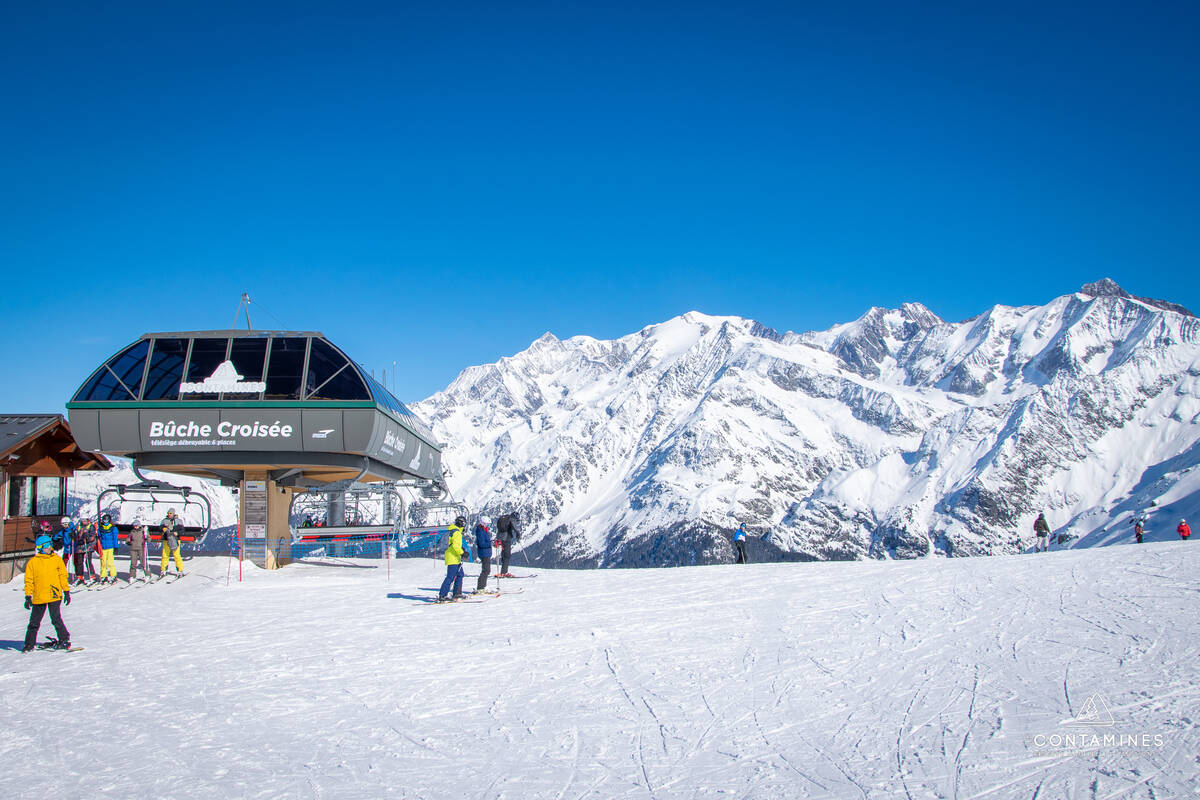
SECMH: The Contamines-Montjoie Hauteluce Ski Area
The Société d’Équipements des Contamines-Montjoie Hauteluce (SECMH) has been certified ISO 9001 (Quality Management System) and ISO 14001 (Environmental Management System). The company has also implemented a Safety Management System aimed at improving employee safety.
In terms of reducing its environmental impact, the ski area operator has implemented several initiatives:
- Eco-driving practices for snow groomer operators
- A snow-grooming plan to optimize vehicle circulation
- Reducing the number of open slopes depending on visitor numbers
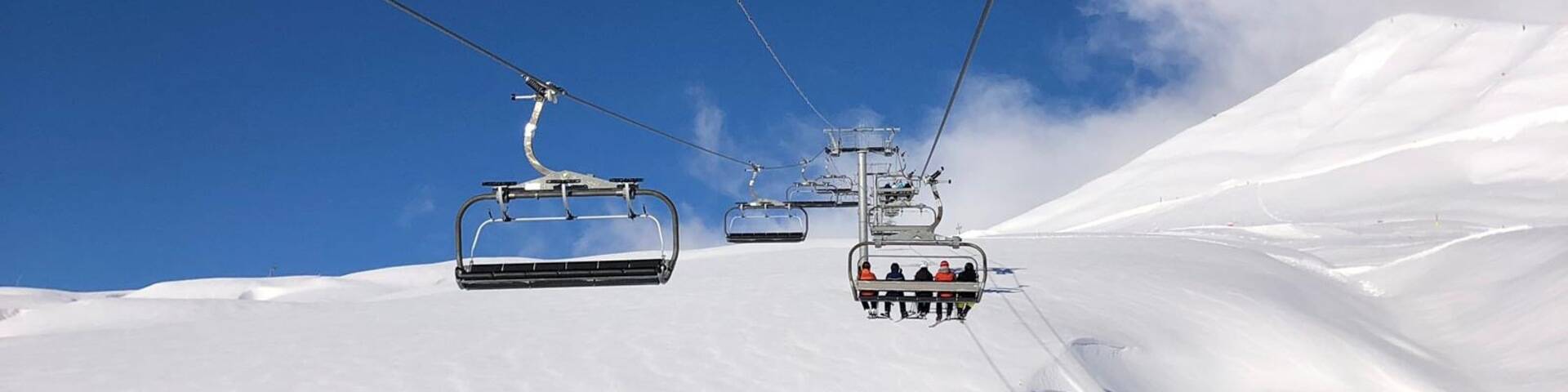
- Reducing lift speeds according to visitor numbers
- Collecting waste across the ski area at the end of the season
- Purchasing bamboo poles (a natural material) rather than plastic ones
- Reseeding and restoring vegetation after the winter season to encourage the return of livestock farmers and their herds during the summer
- Implementing the “Avifauna” system to protect birds from potential collisions with ski lift cables, in collaboration with Asters-CEN74
- Systematic environmental impact assessments for new projects (for example, protecting a plant species—the Superb Pink, Dianthus superbus—in one area of the ski resort)
- A target of reducing the energy consumption of ski lifts by 10%
- Participation in the “Clim Snow” study, which assesses the reliability of snow cover over different time horizons
And many other initiatives that will be highlighted as part of the company’s ongoing CSR (Corporate Social Responsibility) approach.
The “Sème ta Transition” Association
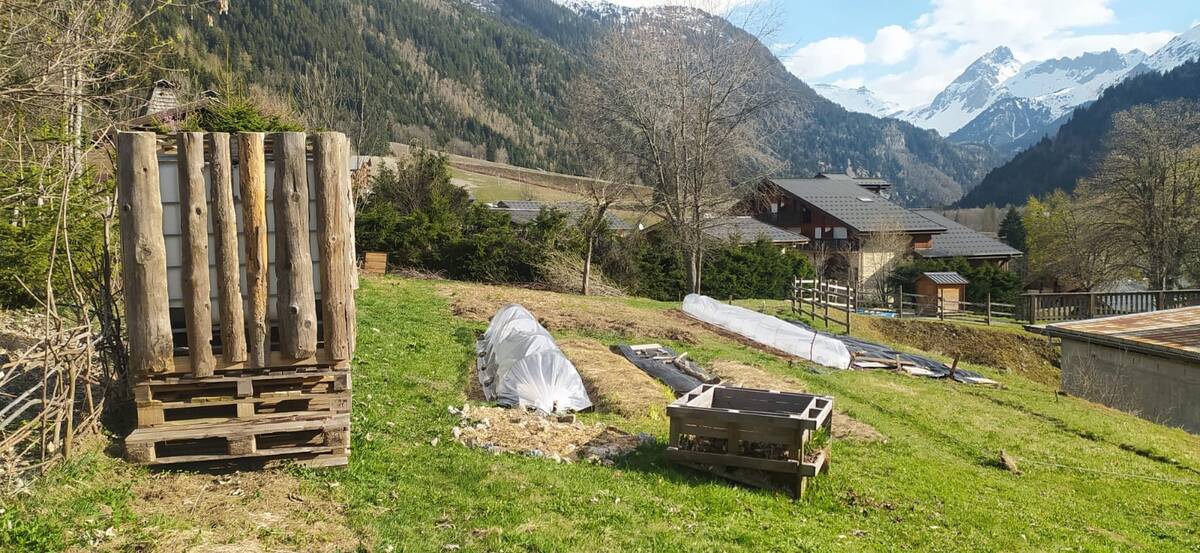
The initiative is a first of its kind: residents of the village of Les Contamines have come together to create a shared community garden, as well as an association called “Sème ta Transition,” reflecting their desire to embrace an environmentally friendly, community-focused and local approach.
Thanks to the support and solidarity of local residents, the association was able to borrow a plot of land and recover a shed donated by the town hall to store the tools needed for cultivation. The aim is ultimately to maintain a garden throughout both summer and winter, at an altitude of 1,164 metres. To achieve this, the association hopes to obtain grants to finance underground greenhouses, commonly known as “walipinis.” This concept originated in Bolivia, and its name comes from an indigenous word meaning “place of warmth.” It helps create a microclimate that makes it possible to cultivate the land during winter: these underground greenhouses are protected from both extreme heat and frost.
All the fruit, vegetables and herbs are organic and grown without pesticides, in accordance with the principles of permaculture, an approach to cultivation that respects biodiversity. The gardeners grow their own seedlings under cover from mid-winter onwards before transplanting them outdoors in summer.
Water for irrigation is collected through five rainwater tanks connected to the roof of the neighbouring building. For the time being, the harvested vegetables are shared exclusively among association members.
The association hopes soon to be able to supply the primary school canteen in Les Contamines-Montjoie with its surplus production. Under the Egalim law, school canteens are required to offer a minimum of 20% organic and locally sourced fruit and vegetables. This is also an opportunity to raise awareness among younger generations about the ecological transition taking place in their village. Primary school children have already taken part in designing the association’s logo, as well as in gardening workshops.
In summer 2022, “Sème ta Transition” also organised an event called “Les Conta’sèment”, in collaboration with the seed association “Kokopelli.” Visitors could exchange or purchase plants and seeds for their gardens, take part in a Climate Fresk workshop, visit the community garden, and more.
The president of Sème ta Transition, Stéphane Vinat, is also a member of the steering committee for the Flocon Vert initiative and is therefore actively involved in the village’s ecological transition.
Refuge des Prés
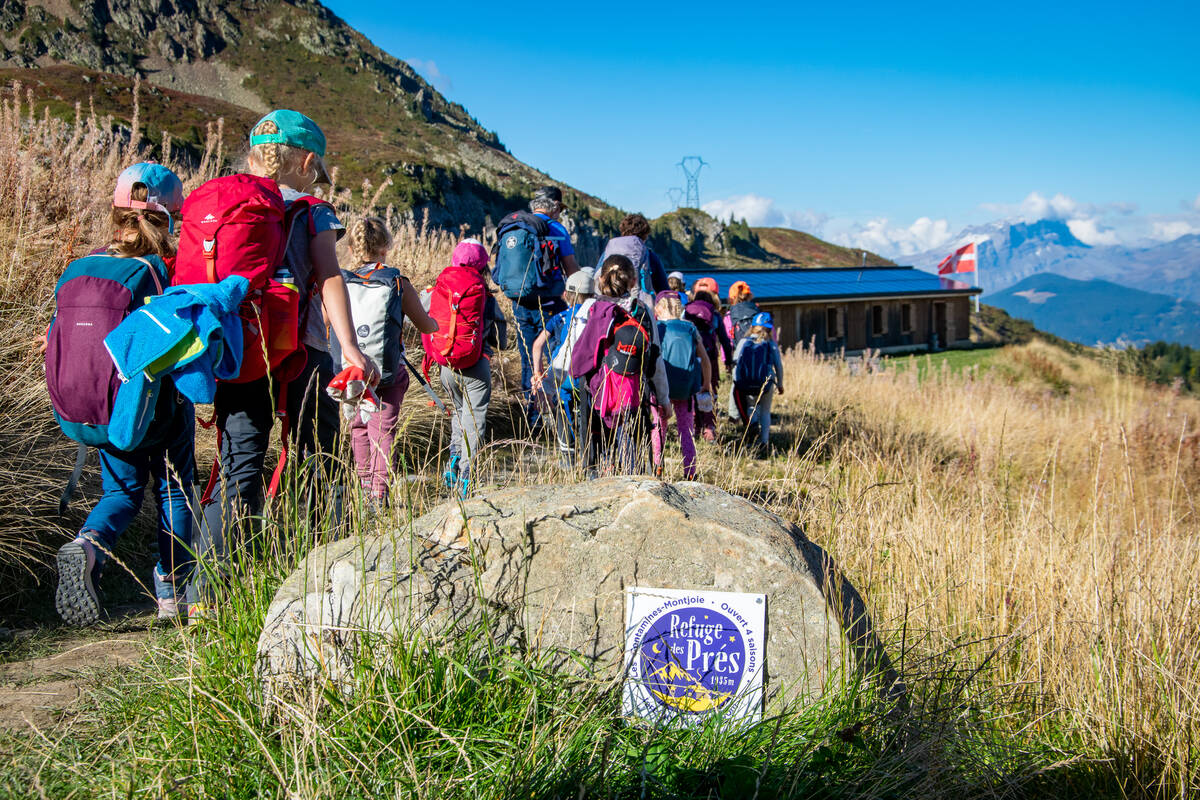
Facing Mont Blanc, at an altitude of 1,935 metres, the new Refuge des Prés in Les Contamines opened its doors in summer 2021, in France’s highest nature reserve. A former alpine pasture has been transformed into an exceptional site, accessible all year round, for hiking and ski touring.
The two hut wardens and their team welcome visitors to an area where no other refuge is open during winter and spring. Ideally located near the Tour du Mont Blanc and the Beaufortain, this refuge is an ideal starting point for hikers. With a capacity of 30 people, it offers small four-person dormitories, a technical room for equipment, a dining room and sanitary facilities. It is a comfortable, high-quality refuge that is heated all year round.
The roof of the refuge is equipped with photovoltaic panels to generate electricity. It is, in fact, the largest photovoltaic installation in the region. In the kitchen, the wardens are committed to serving local, seasonal dishes. They favour short supply chains, sourcing exclusively from producers in the surrounding region.
Accessible to hikers of all levels, the experience is aimed at those wishing to spend their first night in a mountain refuge. It also has an important educational mission, welcoming school groups for two- to three-day stays designed in particular to raise awareness of environmental protection. The first educational stay took place in September 2022 with the CE1-CE2 pupils from Les Contamines-Montjoie primary school. The initiative was organised by the Haute-Savoie Conservatory of Natural Areas (Asters-CEN74) and the guides of the Compagnie des Guides des Contamines.
Le repaire des Curioos
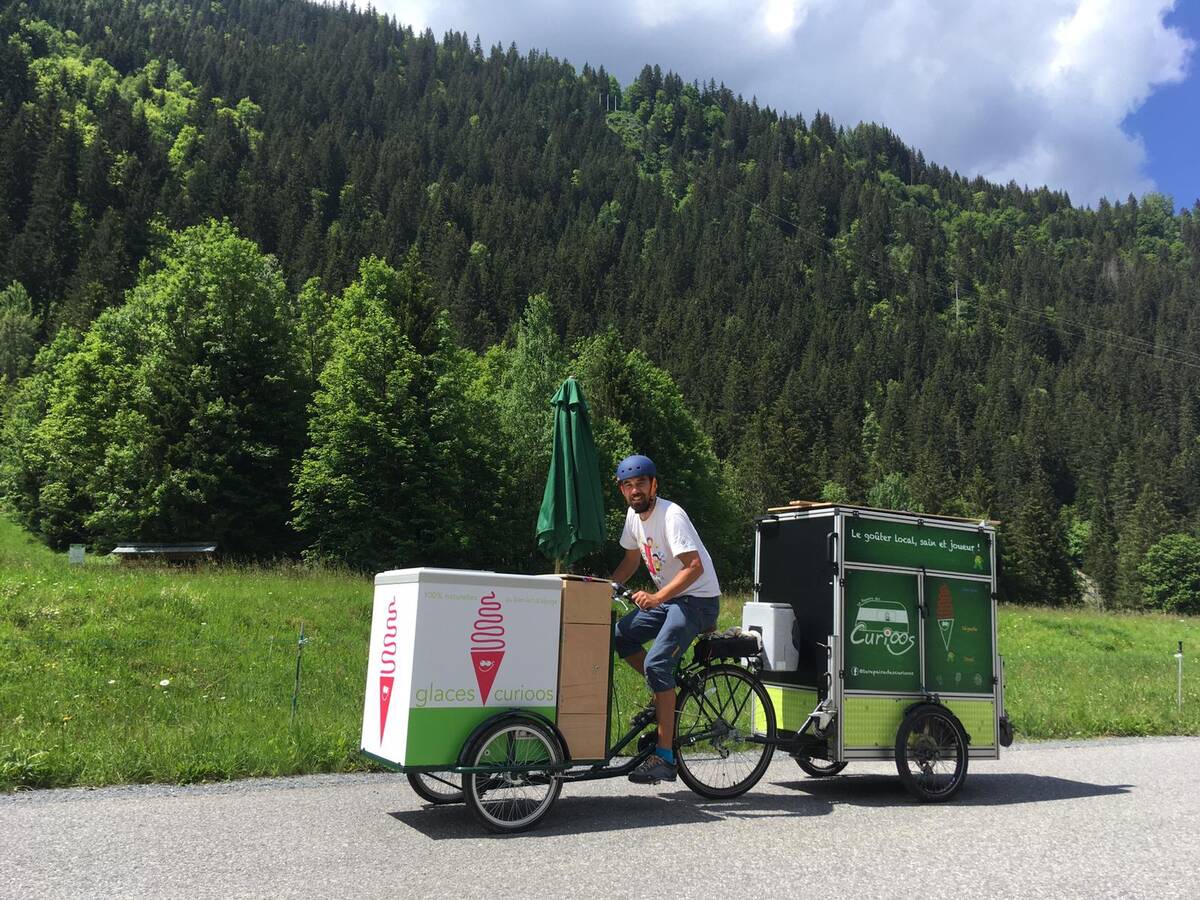
Curioos is something of a pioneer business in the Flocon Vert initiative in the Les Contamines area! Soft mobility, short supply chains... Yann offers delicious homemade and sustainable treats throughout both summer and winter from his food truck, which is mounted on an electric cargo tricycle.
In summer, he makes ice cream using real fruit harvested in the region (Reignier), combined with cow’s milk from a farm in Les Contamines. It can be enjoyed alongside organic, locally produced fruit juices. The food truck is ideally located at Notre-Dame de la Gorge, opposite the church, at the end of numerous hiking trails.
In winter, he serves delicious homemade waffles, again made in particular with cow’s milk from Les Contamines, and travels from the Sabotdance farm to Notre-Dame de la Gorge.
“The cargo tricycle has proved that it is possible to create a very small, four-season local business with a bicycle, original ideas and a great deal of hard work.”
Yann hopes that the example of his small food truck will inspire others and encourage people to cycle more around the village.