
Wild Camping Ban Throughout the Nature Reserve Below 2,500 Meters Elevation from June 15 to September 15
A measure designed to ensure a balance between mountain recreation and the preservation of natural ecosystems.
A Shared Observation Among Local Stakeholders
With the number of hikers steadily increasing in the Contamines-Montjoie National Nature Reserve, wild camping ("bivouac") has grown significantly in recent years, particularly along the Tour du Mont Blanc routes.
For some visitors, bivouacking has become a standalone activity, leading to noise disturbances, littering, informal toilet use, and the erosion and degradation of fragile natural habitats. The growing number of visitors has also created conflicts with the pastoral activities that take place within the reserve. This situation is now widely acknowledged by all mountain stakeholders.
Strengthened Regulations
To allow hikers to continue enjoying natural spaces while preserving their ecological integrity, the Municipality of Contamines-Montjoie, Asters-CEN74 (the reserve's management organization), local stakeholders, and the French government have decided to strengthen bivouac regulations.
A first prefectural decree was issued in spring 2024 to regulate wild camping and swimming around the Jovet Lakes and Plan Jovet areas, which were particularly affected by overcrowding. A new prefectural decree now expands these protective measures.
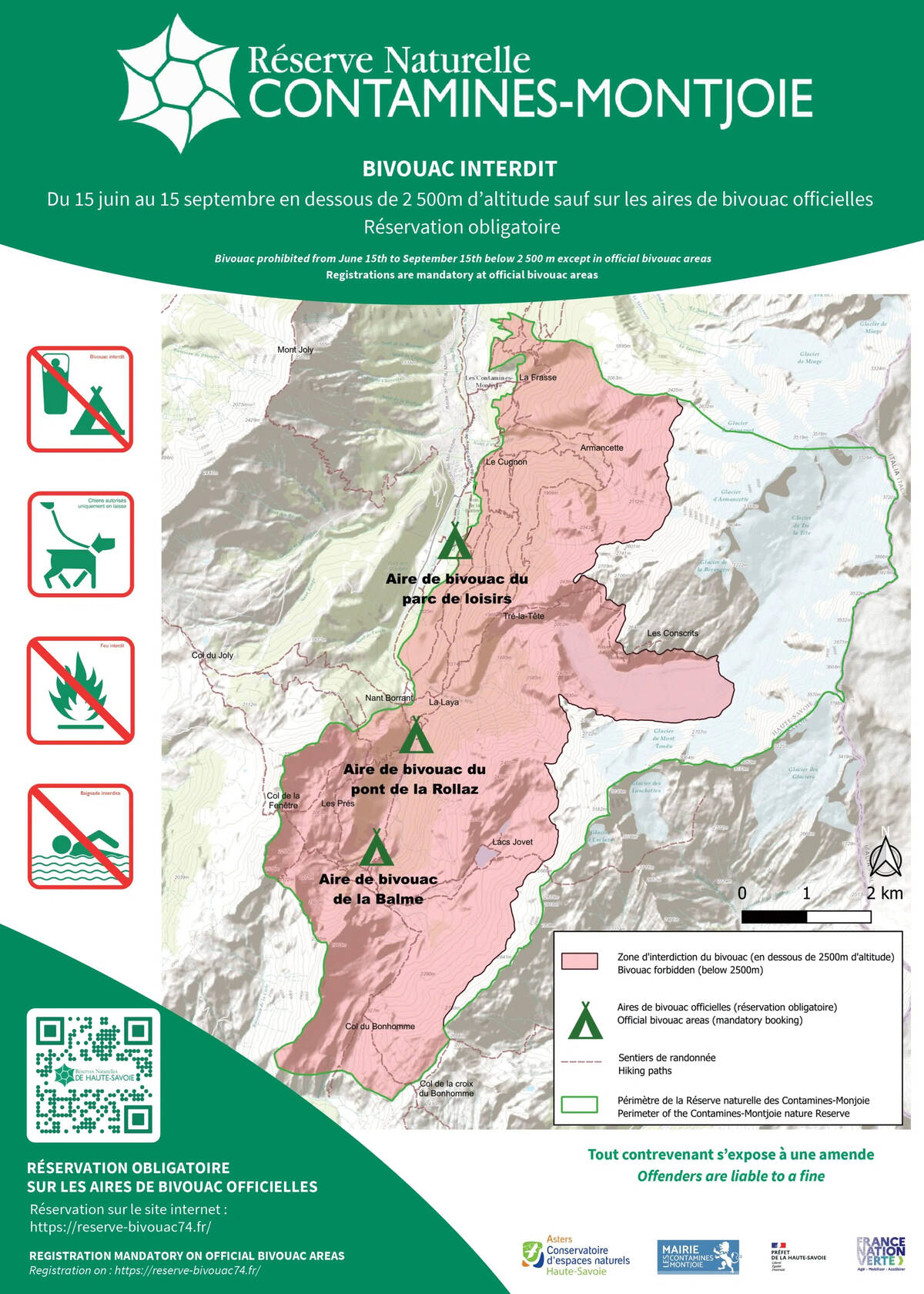
As a result, wild camping is now prohibited throughout the entire Contamines-Montjoie Nature Reserve below 2,500 meters elevation from June 15 to September 15. During this period, only the designated bivouac areas at La Giettaz / Pont de la Rollaz and La Balme remain authorized.
Swimming and boating activities in all lakes and bodies of water within the reserve are prohibited year-round. This ban also applies to pets entering the water.
Appropriate Alternatives
To support this transition and allow hikers to continue enjoying the mountains under suitable conditions, reservations are now mandatory for anyone wishing to bivouac in the reserve's two authorized camping areas.
This booking system helps visitors identify authorized locations and plan their journeys responsibly.
In addition, the Municipality of Contamines-Montjoie will open a new bivouac area of approximately 2,500 m² this summer at the foot of the reserve, within the leisure park. Reservations for this site will also be available through the same platform:
This new accommodation capacity will help relieve pressure on the existing bivouac areas at La Giettaz / Pont de la Rollaz and La Balme while improving conditions for overnight campers.
The initiative has been very positively received by local stakeholders, who consider this additional capacity essential in light of increasing visitor numbers.
Statement from an Elected Official
Basile Dunand, Mayor of Contamines-Montjoie
"In response to the growing popularity of the Tour du Mont Blanc, our responsibility is clear: to manage this growth rather than simply endure it. The new bivouac area, which our new municipal administration will create this summer, reflects this approach: improving the quality of visitor reception without continually increasing visitor numbers.
The Tour du Mont Blanc represents a genuine opportunity for economic diversification, provided that we maintain high-quality standards.
The goal is not to place the mountains under glass, but to protect the most sensitive areas during the peak season while allowing residents and visitors to continue enjoying the mountains to the fullest.
This initiative also reflects a new way of working: collaborating intelligently with the nature reserve, the government, and local stakeholders to achieve a sustainable balance between the economy, pastoral farming, environmental protection, and quality of life."
Prefectural Decree
About the Contamines-Montjoie Nature Reserve
The Contamines-Montjoie National Nature Reserve is managed by the Haute-Savoie Nature Conservation Trust (Asters-CEN74).
Covering 5,500 hectares and occupying two-thirds of the municipality of Contamines-Montjoie, it is the highest national nature reserve in France.
The reserve offers a remarkable diversity of landscapes, ranging from glaciers and alpine meadows to forests and peat bogs, across an elevation difference of 2,800 meters.
In addition to its exceptional scenery, visitors can observe a rich variety of wildlife, including iconic Alpine species such as chamois, ibex, and marmots.
The reserve is also home to an exceptionally rich flora, with more than 760 plant species, some of which are rare and protected.
Nearly 200,000 people visit this extraordinary area each year. However, it is essential to recognize the fragility of these natural environments and the potential disturbances that visitor activity can cause to wildlife.